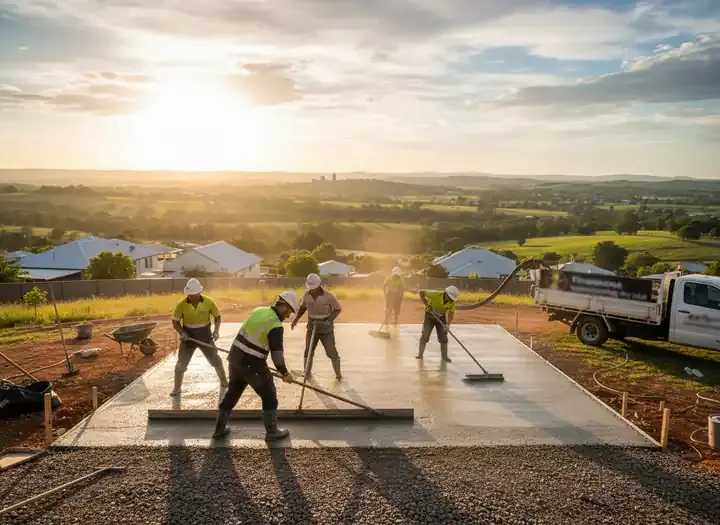
Concreting in Drayton means working around some of the oldest housing on the Darling Downs alongside newer units and homes. Most driveways, paths and slabs here are routine, but the age of the house, the volcanic soil underneath and whether the lot sits under a flood overlay all shape how the job is planned and priced.
Concrete work for old and new Drayton homes
Typical jobs include replacement driveways, new paths and patios, and slabs for sheds or carports. On mid-century homes that often means breaking out tired concrete first. On newer lots it is more often a fresh pour, with formwork set against existing edges, garden beds and paving.
From 1800s houses to 2000s units
Drayton mixes a core of 19th-century houses, a large band of mid-1900s homes and shops, and detached houses and units mostly from the 1990s and 2000s. Older sites can need careful demolition, tight access or reinstated paving around original features, while newer ones usually need concrete matched to existing slabs and levels.
Why ground conditions drive the slab decision
Toowoomba sits largely on basalt-derived volcanic soils, and these can change from one lot to the next. That affects excavation depth, base material and how a slab is reinforced. If a contractor asks about site classification or suggests testing for a larger slab, treat it as a sensible step rather than an upsell.
Paperwork that protects a larger Drayton pour
On a larger Drayton pour, ask the contractor to put their licence and warranty details in writing before you agree a date. Building approvals remain the homeowner's responsibility before work starts.
Next step: date the house and map the low corners
Before asking for a free quote, work out roughly when your home was built and whether old concrete must come out. Measure the area, photograph where water collects after rain and check the overlay map for your lot, so the price reflects a real Drayton site rather than a guess.
Local facts for Drayton
- •Heritage-listed places such as the Royal Bull's Head Inn on Brisbane Street, St Matthew's Anglican Church on Glennie Street and Drayton State School sit within the suburb, so concreting close by may raise streetscape, access or approval questions worth settling early.
- •Mount Peel rises to 711 metres in the north-west of Drayton, so blocks on its lower slopes may need closer attention to falls, edge support and how a concrete truck reaches the pour.
- •Some Drayton lots fall within the Toowoomba Region Flood Hazard overlay or the Emerging communities zone, so confirm the mapping for your exact lot before fixing slab heights, falls or drainage.